Incident Triage & Auto-Resolution
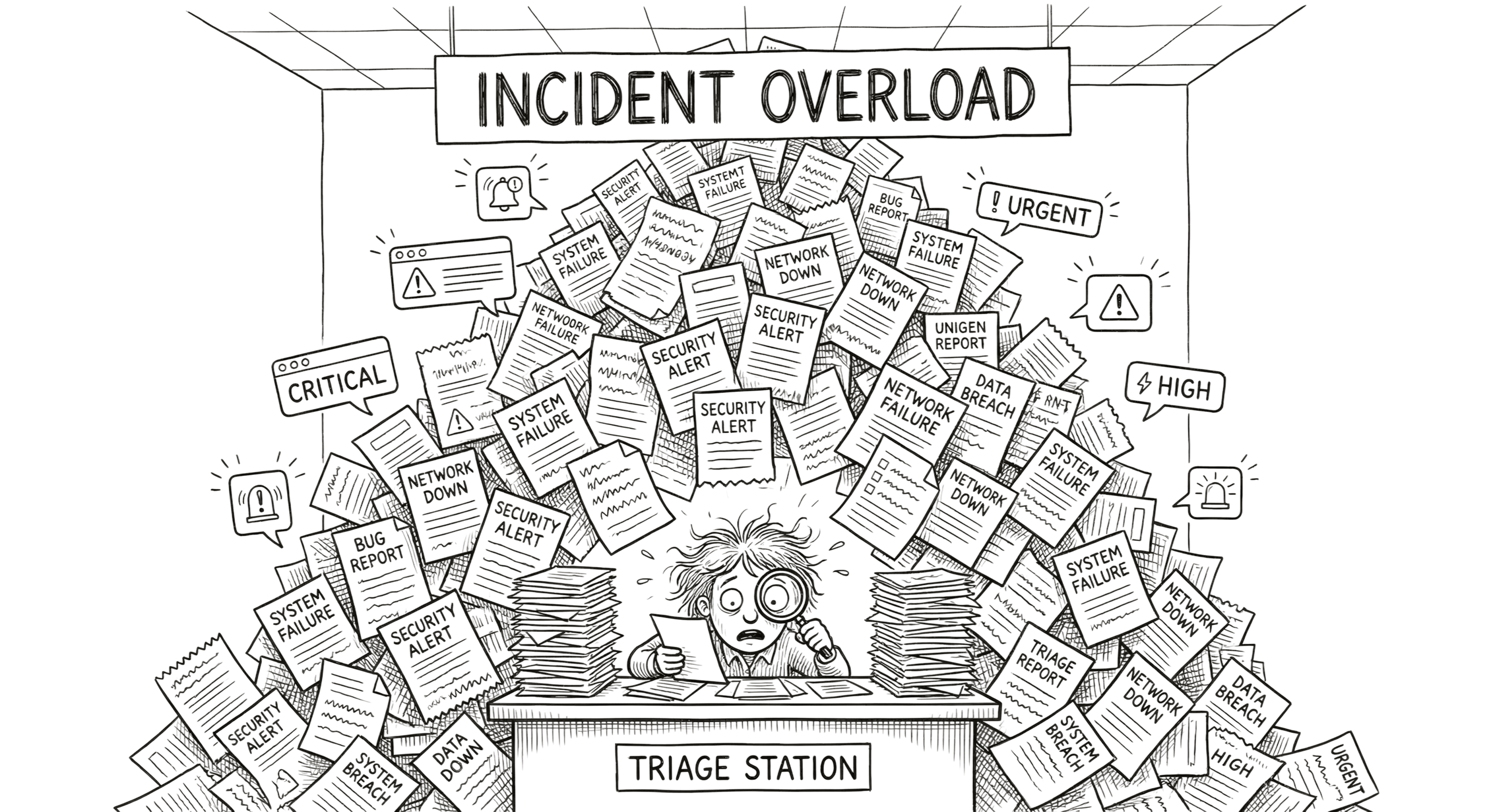
Enterprise IT organizations handle thousands to tens of thousands of incidents monthly. L1/L2 service desk teams spend 60-70% of their time on repetitive tasks—password resets, account unlocks, software installation requests, and basic troubleshooting. Traditional ServiceNow workflows rely on manual ticket review, categorization, assignment, and resolution, creating backlogs, poor user experience, and high operational costs. Meanwhile, 40-60% of tickets could be auto-resolved with proper context and reasoning.
Related IT Service Management workflows: change risk assessment & approval automation and access request automation, part of the ITSM suite. See our HiFi benchmark for IT service management.
Workflow goal
Intelligently triage incoming incidents, auto-resolve repetitive requests, and route complex issues to the right resolver—reducing L1 workload by 50-70% while improving mean time to resolution (MTTR).
VP of IT Operations
Service Desk Manager
Incident Management Team
End Users
End-to-End Agentic Flow
1
Ticket Intake
Ingest incident from ServiceNow (email, portal, chat, phone)
Parse description, urgency, affected user/service
2
Intent Classification
Identify true issue (password reset, access issue, application error, hardware problem)
Determine if auto-resolvable or requires human intervention
Extract relevant context (user role, location, affected systems)
3
Context Assembly
Pull user profile, recent tickets, asset information
Check knowledge base for similar resolved incidents
Query monitoring systems for related alerts or outages
4
Auto-Resolution Attempt
Execute standard remediation (reset password, unlock account, restart service)
Validate resolution through automated checks
Update user with solution and close ticket
5
Intelligent Routing (if not auto-resolved)
Categorize by technical domain (network, application, infrastructure)
Assign to appropriate resolver group based on skills and availability
Enrich ticket with context and suggested troubleshooting steps
6
Knowledge Capture
Identify novel resolution patterns
Flag incidents for knowledge article creation
Update resolution playbooks
Natural language understanding for ticket parsing
Multi-system context gathering
Automated remediation with validation
Intelligent routing logic
Confidence threshold for auto-resolution (typically 85%+)
Approval required for high-impact actions
User confirmation for password resets and account changes
Read/write access scoped to specific ServiceNow operations
Auto-resolution rate (target: 40-60%)
Mean time to resolution (MTTR)
First contact resolution (FCR) rate
L1 deflection percentage
User satisfaction scores (CSAT)
Manual intervention rate