A credit reporting agency builds its risk assessments from a wide variety of publicly available sources — newspapers, court proceedings, regulatory filings, records filings, sanctions lists, and government records. The raw material is inherently messy: it arrives as multi-modal content (text, scanned documents, tables, and images) across many languages, and the same entity is often referred to inconsistently from one source to the next.
Analysts must locate the relevant records for each party, read and interpret them, reconcile conflicting or partial information, and record a standardized summary into an internal database. Done manually, it is a tedious, judgment-heavy process repeated every day across a large team — and one that scales only by adding people.
The requirements of AI agent automation
To automate credit research, AI agents have to do far more than scrape pages. They need to gather content from many disparate public sources, understand multi-modal and multilingual material, extract the specific entities and events that bear on creditworthiness, and resolve them against the agency's internal records even when names and identifiers only approximately match.
Just as important, every extracted fact has to be traceable back to its source and expressed in a consistent, schematized format so that downstream risk models and human reviewers can trust it. This blend of open-ended research, judgment, and rigorous, auditable structure is exactly where Thunk.AI's agentic approach fits — and where legacy RPA and rules engines fall short.
The automated AI-agent-powered workflow
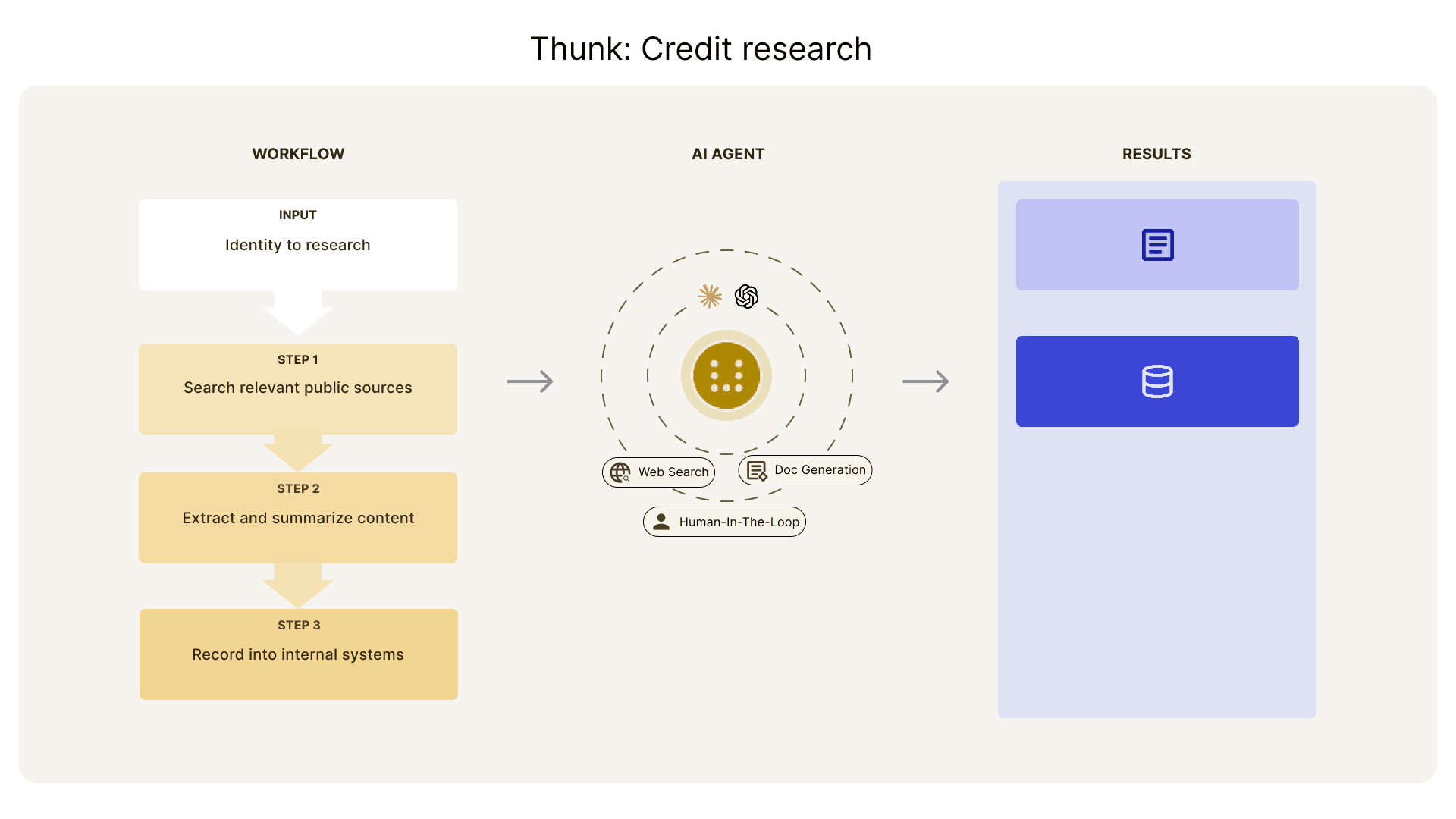
Instead of analysts processing this content manually, AI agents built on Thunk.AI carry out the same process automatically: discovering and retrieving source material, extracting and normalizing the relevant information, matching it to internal records, and writing a standardized summary back for downstream use — with a full audit trail behind every entry.
This is one of several document- and research-heavy workflows Thunk.AI automates. Explore a related example in large-scale document processing, see how a compliance team approaches investigation in AML alert triage and SAR drafting, or explore the full Financial Services suite.