DSUR & PBRER Automation
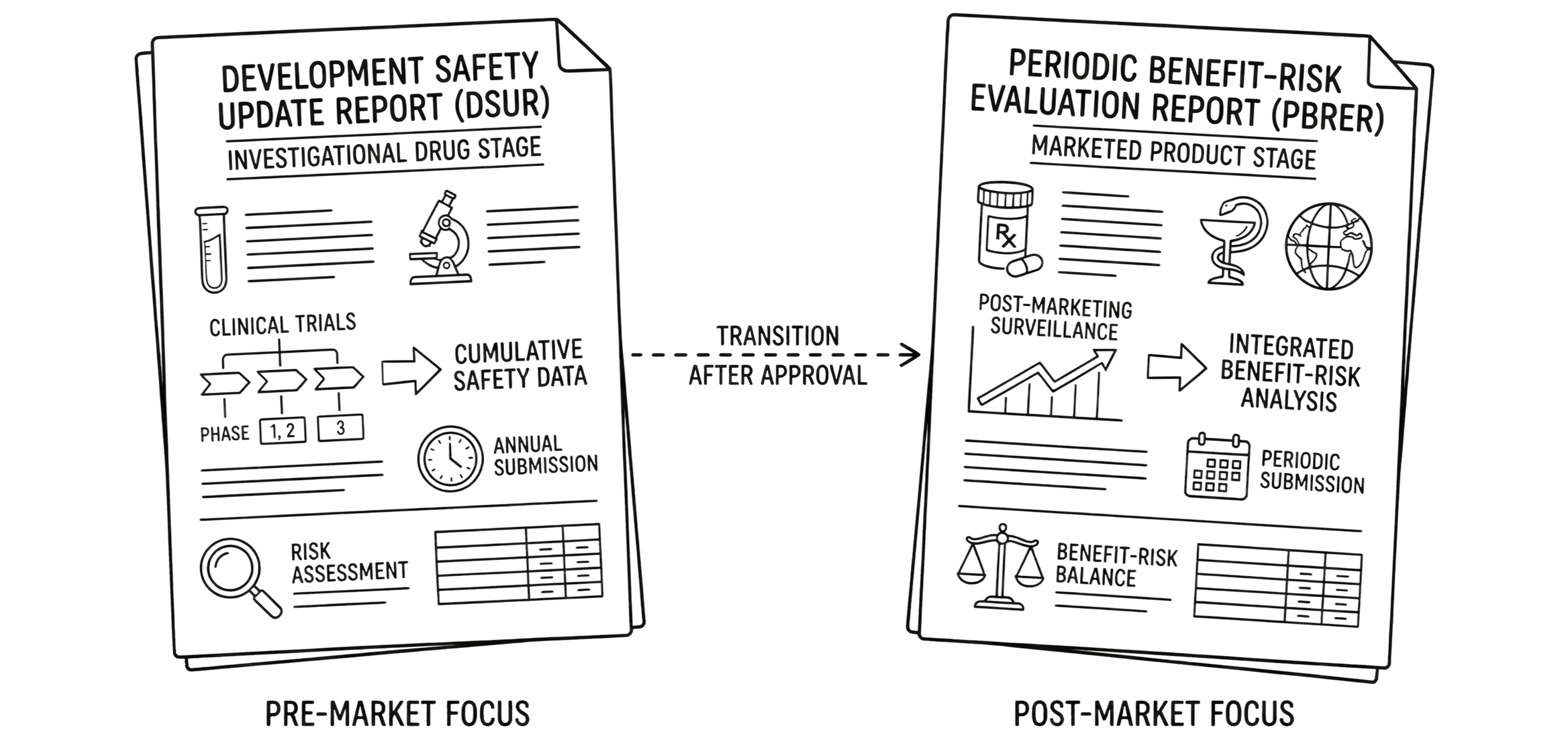
Periodic safety reporting—Development Safety Update Reports (DSURs) and Periodic Benefit-Risk Evaluation Reports (PBRERs)—demands comprehensive aggregation of clinical safety data, literature reviews, and integrated benefit-risk analysis, all formatted to exacting ICH E2F and E2C(R2) standards. Pharmacovigilance teams spend 4-6 weeks per report on manual data extraction, signal detection, and narrative synthesis, creating capacity bottlenecks and delaying submissions.
On Thunk.AI, agents aggregate adverse-event cases, exposure data, and safety literature, run disproportionality and trend analyses to surface signals, and draft ICH-compliant tables and narratives for drug-safety physicians to review and approve. Pharmacovigilance teams move from weeks of manual assembly to days, without giving up medical oversight or auditability.
Related Life Sciences workflows: CAPA & root cause analysis and CMC variation management, part of the Life Sciences suite.
Workflow goal
Automate safety data aggregation, signal detection, and ICH-compliant report generation to reduce preparation time to 3-7 days while enhancing signal identification quality.
Stakeholders
Head of Pharmacovigilance
Drug Safety Physicians
Safety Scientists
Regulatory Affairs
End-to-End Agentic Flow
1
Data Aggregation
Extract adverse event cases from safety databases
Retrieve clinical trial exposure and efficacy data
Pull relevant laboratory and vital sign data
2
Signal Detection & Analysis
Perform disproportionality analyses (PRR, ROR, EBGM)
Identify emerging safety patterns and event clusters
Conduct temporal trend analysis
Compare against therapeutic class benchmarks
3
Literature Surveillance
Search medical literature databases (PubMed, EMBASE)
Filter for safety-relevant publications
Extract key findings and case reports
4
Report Generation
Generate all required ICH tables and line listings
Synthesize safety narratives with signal assessments
Integrate benefit-risk analysis sections
Ensure cross-referencing and data consistency
5
Medical Review
Route draft to pharmacovigilance physicians
Incorporate clinical interpretation and feedback
Validate data accuracy and completeness
6
Quality Assurance & Approval
Automated validation checks
Electronic signature workflow
Generate submission-ready PDF
Platform features highlighted
Multi-database integration and reconciliation
Advanced statistical signal detection
Automated literature monitoring
ICH-compliant formatting and validation
Medical officer review of AI-generated narratives
Safety scientist validation of signal assessments
Quality assurance review before submission
Read-only access to safety databases
Report preparation time (weeks → days)
Signal detection sensitivity
Data consistency error rate
ICH format compliance
Submission timeline adherence